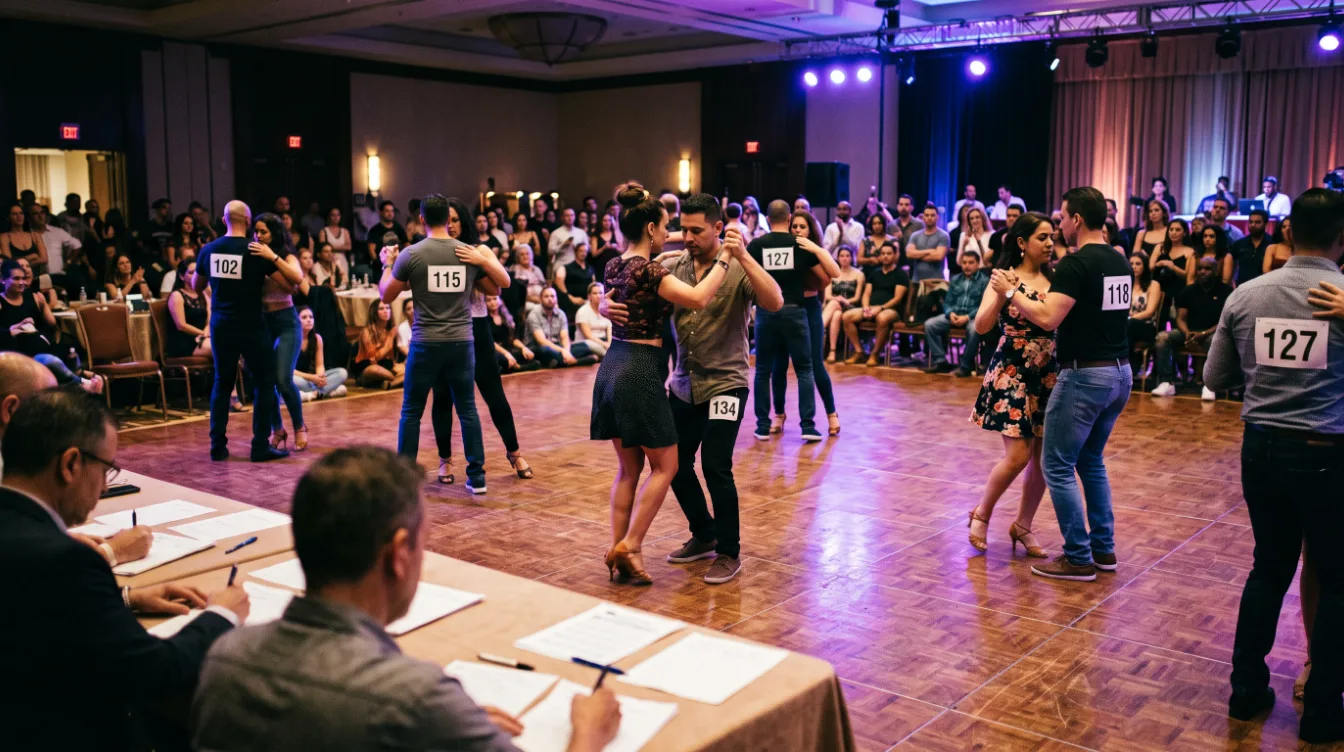
- A Jack and Jill is a social dance competition: partners are drawn at random and the music is not announced.
- Leaders and followers are usually judged separately, so your score is yours even though you dance as a pair.
- Judges look for lead and follow, connection, musicality, technique and personality, not tricks.
- No lifts, no acrobatics and no choreography. Dance like your best social dance.
- BCR runs a Jack and Jill on Saturday 27 February 2027 as the Czech qualifier of the Bachata Social World Cup.
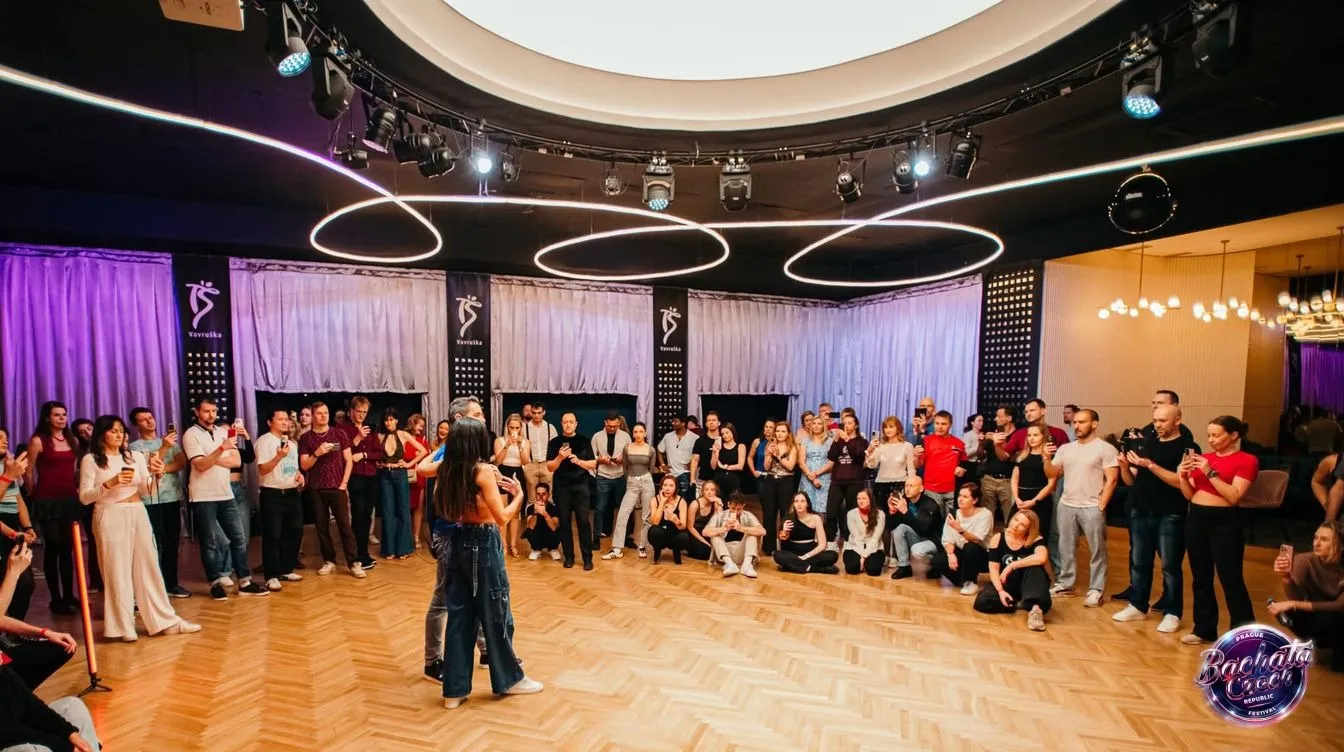
A bachata Jack and Jill is a Jack and Jill dance competition danced to bachata: leaders and followers are paired at random, the music is not announced and there is no choreography. It is the competition social dancers love most, because it rewards exactly what you do every night at a party: lead or follow someone you may never have danced with, to music you did not choose. There is no routine to learn and no partner to find. You sign up as a leader or a follower, and the draw does the rest.
At Bachata Czech Republic Festival in Prague the Jack and Jill runs on Saturday 27 February 2027 and is the Czech qualifier of the Bachata Social World Cup. This guide explains the format in general, so it is useful whichever festival you compete at.
What is a Jack and Jill in dance?
The name comes from the nursery rhyme: Jack is the leader and Jill the follower. Competitors register in one role and are paired at random, often new for every round. The DJ plays songs nobody knows in advance, and several couples dance at the same time while judges watch from the edge of the floor. The format started in West Coast Swing and has spread to salsa, kizomba and bachata, where it is now a fixture at international festivals.
Because you cannot rehearse, a Jack and Jill tests real social dancing: how clearly you lead, how well you follow, how you react to the music and how you make an unknown partner look good.
How the rounds work
The structure varies a little from event to event, but most bachata Jack and Jills look like this:
- Registration. You sign up as a leader or a follower. Places per role are often limited so the numbers match.
- Preliminaries. Large heats with several couples on the floor at once. Partners usually rotate between songs, so judges see you with more than one person.
- Semi-finals, if the field is big enough, with fewer couples and new partners.
- Finals. A new draw, often in front of the whole festival. Some finals start with all couples dancing together, followed by a short spotlight for each couple.
At BCR the preliminaries run around midday on Saturday and the finals open the gala night, before the artist shows and the party. Places are limited to 50 leaders and 50 followers. The full timetable is on the program page.
What judges look for
Every competition publishes its own criteria. The BCR judges use these, and they are a good guide anywhere:
- Lead and follow quality: clear, comfortable leading and attentive following, adapting to each partner, and floorcraft in a crowded heat.
- Technique: clarity, smoothness, control, lines and balance.
- Connection with your partner and with the music.
- Musicality: timing, interpretation of breaks and accents, creativity.
- Personality: presence, authenticity and energy.
- X-factor: the something that makes a dance memorable.
Leaders and followers are usually scored separately. If your partner has a hard round, a calm, generous dance from you still counts.
What is not allowed
A Jack and Jill is a social dance competition, so anything you would not do on a crowded social floor is out. At BCR that means no lifts, no acrobatics and no choreography. Your competitor number must stay visible, and the dress code is stylish and comfortable, not costumes. Check the rules of each competition before you enter. They are short, and judges apply them.
How to prepare for your first Jack and Jill
- Dance with strangers. The best training is socials where you ask people you have never danced with. That is the competition.
- Train to unknown music. Ask a friend to play random bachata songs and dance without stopping: modern, traditional, slow, fast. Our list of bachata songs for dancing is a good start.
- Know your basics cold. A clean basic step, clear turns and a steady frame beat a long combination you are not sure of.
- Prepare a few musical ideas, not a sequence: something for a break, something for a slow passage, something for the final note.
- Film a social dance and watch it. Posture, timing and where you look show up straight away.
Tips for the day
- Warm up properly. Heats are short and you want your best dance in the first eight counts.
- Greet your partner with a smile and a few words before the music starts.
- Listen to the first phrase before you show anything. Judges notice dancers who wait for the music.
- Keep it comfortable. A happy partner makes both of you look better.
- Use the space you have. Crashing into another couple costs more than any trick wins.
- If something goes wrong, keep dancing. Recovery is part of social dancing and judges see it.
- Finish with the music, then thank your partner.
Why enter at all?
Because it makes you a better social dancer, whatever the result. Preparing for a Jack and Jill sharpens your basics, your musicality and your attention to your partner, and the competitors' area is one of the friendliest places at any festival. At BCR the champions in each role win a cash prize, a full pass for BCR 2028 and direct qualification for the Bachata Social World Cup Finals in Geneva. Second and third places also win passes. The details are on the competition page.
How to enter at BCR
Entries are handled by the Bachata Social World Cup. You register on their platform as a leader or a follower, then we email you the next steps and a payment link for your competitor pass. If you already have a full pass, it covers the festival, and you still register for the competition on the World Cup platform. Everything is explained on the competition page.
Questions people ask
What is a Jack and Jill in bachata?
How are bachata Jack and Jill competitions judged?
Can I do lifts or tricks in a Jack and Jill?
Do I need a partner to enter a Jack and Jill?
When is the Jack and Jill at Bachata Czech Republic Festival?

Jorge and Mónica are professional bachata dancers with more than fifteen years of teaching behind them. They run Jorge y Mónica Academy in Prague, organise Spanish Bachata Training Camp and Bachata Czech Republic Day and Night, and founded Bachata Czech Republic Festival, whose first edition in 2026 brought 600 dancers from more than 40 countries to Prague.